Support Us: Please visit our sponsors

.Mac (Apple Computer, Inc.)

Sponsor

Apple iTunes

Thursday, January 31, 2008

Building A Home Studio, Revisited

Sound and Recording
B. Thomas Cooper
Editor

Once upon a time, not too long ago, mind you, building a respectable home studio' required a rather substantial investment in time and money.

Back in the day, so to speak, we were still recording in analog, and a decent eight track tape machine cost a few thousand dollars at a minimum. Then there was the console (desk, mixer, etc.) consisting of perhaps twenty-four channels, which cost another couple grand. Of course, no home studio was complete without at least a couple racks of outboard gear. We had doozles and raddoids and multiple compressors and delay devices, each guaranteed to muddy up the mix. All of this was then routed together with cables and wires and strewn about in disarray. Getting it all to sound good was never an easy task.
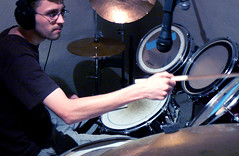
nick_drums
Nick Gill in Studio A

These days things are little different. The advent of digital technology has changed much about how we record sound and music. Oh, we still have our share of doozles and raddoids, but now they are called add-ons' and they are included with the recording software. Most of the clumsy cables have long been chucked into the trash. We like to run a clean shop

Over the years, I have designed and overseen the construction of countless studios. It's one of those things I do. From coast to coast, from sea to shining sea. Big rooms, little rooms they are all the same. The trick is to create an environment conducive to the recording process. The best advice I can give is learn to keep your sound pressure levels under control. Deafening volume levels are not a good idea in small enclosures. When in doubt turn it down.

There are numerous companies offering digital recording software at reasonable prices. The choice is yours. For starters, I recommend Sonar for the initial recording process and Sound-Forge for the mastering process. It's really not as hard as it sounds, and these days even a caveman like myself can afford it.

In any studio, a bad headphone mix is as inexcusable as it is predictable. How in the name of Marilyn Manson can anyone expect to lay down strong basic tracks if you can’t hear what the other musicians are doing? The same holds true for the overdub process. A musician is only as good as his (or her) ears. If the sound in your cans doesn’t rock, your not apt to perform at your best.

For this, I recommend Samson 4 C-que 8 headphone amplifier, ideal for small studio applications, addressing many of the problems associated with typical inferior headphone mixes.

With a retail price of around $149.00, the Samson 4 C-que 8 is a safe and affordable solution. It fits nicely on the desk or console, and my unit has yet to throw me any curves. This is a quality device with no apparent drawbacks. I would recommend the Samson 4 C-que 8 to anyone serious about their workstation or studio headphone mixes.

Obviously, you will also need reliable headphones. Again, you are only as good as your ears can hear. I suggest a couple pairs of Sony V600’s These are a fine offering by Sony, a sturdy set of headphones, with firm, comfortable ear pieces and a warm, desirable frequency response. In simple words… a good investment for anyone looking for a reliable set of headphones.

You will also need an array of dependable microphones, but this subject is covered in great depth in a separate article. Also available at Helium. If you are new to recording, take a few minutes and read a few articles on the subject. You just might learn something!

Tuesday, January 29, 2008

Recording Keyboards and Synthesizers

Sound and Recording
B. Thomas Cooper
Editor

Over the years, I have learned not to be surprised by people who go to great lengths pontificating on subjects they no nothing about. Unfortunately, this happens far too often, and the subject of recording synthesizers has proven no different.

For starters, it is very rare to record a synthesizer running through an amplifier during a studio session. I have known exceptions, of course, but not many. This is simply bad science, and is not indicative of the process. Put away your microphones, we are running this baby direct.

B. Thomas Cooper
B. Thomas Cooper

As a staff producer for the legendary Power Station, I worked on an array of projects, ranging from standard Jazz to Meat Loaf. Most of the Meat Loaf keyboard arrangements were recorded meticulously over a period of many months. This was usually assigned to a studio wizard by the name of Jeff Bova, who worked in his own facility, with no other musicians in the room. He would have little use for an amplifier under these conditions. A good set of headphones however, were of priceless value.

Live recording is somewhat different, but even then, a direct signal is tantamount. Unless the sound you are trying to achieve can only be accomplished through an amplifier, why would we even haul the amp out of the closet?

Furthermore, and like it or not, when a major act records live, you can bet the bank the recordings were brought back to the studio, where entire parts are added or re-recorded. A keyboard part run through an amp would likely be replaced for fidelity reasons alone. This is big business, folks. We don't make junk when we don't have to.

Still, feel free to experiment as you wish. There are no hard and fast rules that can't be broken. Recording should be fun, and the results artistically satisfying. Approach each aspect of recording with an open mind, and again, by all means, enjoy the experience.

Friday, January 18, 2008

Fresh As a Daisy - Chasing Unique Sounds

Sound and Recording
B. Thomas Cooper
Editor

For myself, one of the more intriguing aspects of the recording process is the merging of art and Science. When the two work in tandem, the results can be magical.

As such, it has long been the desire of many an artist or producer to create fresh sounds, something indeed unique. Predictably many long studio hours have burned away during such pursuit. Guitar tone, drum sounds, even vocal treatments are fair game, but just how much of this is really necessary?

For starters, let's try to focus on the song. When the song is right, it will usually tell you what it needs. A good producer will often recognize a songs strengths or weaknesses rather quickly. It's all about the song. A good song will always outshine the production sensibilities.

Of course, over the years there have been a number of songs that greatly befitted from unique recordings. Early examples include Do the Mess Around, written by producer Ahmet Ertegun and recorded by the legendary Ray Charles. The recording itself is of very poor quality, but the performance is truly and purely magical.

Another example of a unique recording comes to mind. Telstar, recorded by English producer Joe Meek, represents some of the most imaginative techniques ever applied to recording. Of course, Joe himself was more than a tad unique. I strongly recommend his work to anyone interested in the history of recorded music.

There are many more. Crimson and Clover, by Tommy James, and more recently, the early recordings of Nine Inch Nails, and industrial genius, Scraping Fetus From the Wheel. In each case, the uniqueness of the recordings were tantamount to their appeal.

The question as to how one should approach such a process is subjective at best. Obviously, if creating fresh sounds was really that easy, everyone would be doing it, which is far from the case. Let the song dictate what it needs and try to keep an open mind. Most of all relax and enjoy the ride. This is your experience. Make the best of it.

Sponsor

TigerDirect

Sponsor

Netflix, Inc.